
Friday, 1 May 2009
EQ Magazine - special issue on learning spaces

Tuesday, 28 April 2009
Call for posters - 3rd Annual Conference of Technology Supported Learning in the 21st Century
Are you using Web 2.0 tools to support student learning in post-16 education or have you done exciting work in any of the following areas at the cutting edge of technology supported learning?
- Sustaining creative cultures
- Learner-led models of technology supported learning
- Changing academic identity and practice
If so, the 3rd Annual Conference of Technology Supported Learning in the 21st Century is looking for practitioners to present posters. The conference takes place at
If you would like to present a poster, please submit an abstract of no more than 250 words to Christa Appleton (contact details c.appleton@staffs.ac.uk) by
See http://www.staffs.ac.uk/tsl09conference for full details of the conference themes and programme.
Monday, 16 February 2009
effective use of social software report & case studies now available
 This JISC funded report, and collection of 26 case studies, which examined the effective use of social software in the UK further and higher education sectors in enhancing student learning and engagement is now available for download at www.jisc.ac.uk/whatwedo/projects/socialsoftware08.aspx.
This very readable report provides insights about the:
- educational goals of using social software tools;
- enablers or drivers within the institution, or from external sources which positively influence the adoption of social software;
- benefits to the students, educators and institutions;
- challenges that may influence a social software initiative;
- issues that need to be considered in a social software initiative.
I'd like to end this blog post with a quote taken from the study:
"When I thanked an educator, associated with one of the initiatives investigated in this study, at the end of a long day of interviews with her and her students, she said: ‘my heart is with the learners; if I know that something works for them, I want to share it with others so that other learners can also benefit; that is what we are here for - to help our learners’. This statement embodies the spirit of this study: the willingness of colleagues to share their experiences with the wider community."Quote from study author
Tuesday, 13 January 2009
Evaluating Learning Spaces Newsletter
 Following the first JELS (JISC Evaluating Learning Spaces) Study Workshop, the first JELS newsletter has been published and is available for download from the project website at http://www.lsri.nottingham.ac.uk/jels/news.php. The newsletter provides a review of the activities of the first workshop, along with an overview of the aims of the project itself. The follow-up Learning Spaces Workshop is due to take place on 24 February. If you are interested in taking part in the study, or final workshop the team would be interested to hear from you- www.lsri.nottingham.ac.uk/jels/contact.php
Maximising the effectiveness of virtual worlds - presentations available online in real-time
 The 'Maximising the effectiveness of virtual worlds in teaching and learning' event in Glasgow (jointly organised by Eduserv and CETIS) this week has been fully subscribed for some time, however for those still wishing to attend (if only virtually) may be interested to know that Andy Powell from Eduserv is planning to make the audio and slides of all the presentations available in real time on Eduserv Island in Second Life.
Audio will be made available using the SL voice chat facility and copies of all the speakers' slides will be visible in-world. Andy is also going to try and allow for questions to speakers from virtual delegates via text chat.
Virtual delegates should make their way to the Virtual Congress Centre on Eduserv Island:
http://slurl.com/secondlife/Eduserv%20Island/155/33/32
Presentations start at 10.30am (2.30am SL time) though Andy suggests getting there a little earlier to test out audio, etc. Delegates are welcome to drop in for only those presentations that interest them. The full programme is available at http://wiki.cetis.ac.uk/CETIS-Eduserv-VW2009.
Friday, 5 December 2008
IPR in the web 2.0 world: animation
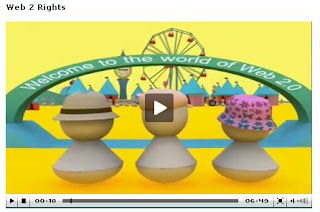 This new six-minute animation highlights the importance of considering IPR in the use and re-use of interactive Web 2.0 technologies such as blogging, podcasting and other multimedia and links back to the very helpful free Web2Rights online diagnostic tool. The tool provides a step-by-step user guide to ensure the protection of both their and others’ copyright in using, deploying and repurposing content.
The animation presents the issues in an accessible, colourful and light-hearted way via three typical case studies: a researcher, a lecturer and a student. These examples pinpoint areas where confusion often exists, or even where many may not consider IPR to be an issue at all, and signpost back to the online diagnostic tool for further guidance and information.
Web2Rights is a JISC funded project, whose purpose is to develop a practical, pragmatic and relevant toolkits to support the projects funded within the JISC Users and Innovation Programme in their engagement with next generation and Web2.0 technologies and emerging legal issues, such as IP, libel and accessibility.
Thursday, 4 December 2008
the digital student
 A JISC sponsored supplement, 'Digital student' was published in the Guardian on Tuesday, exploring the achievements of institutions (with the use of various technologies) and some of the future challenges as universities and colleges look to exploit technology and place the student experience at the heart of learning and teaching.
The kinds of technologies that have placed technology at the heart of the learner experience such as podcasting, wikis, immersive worlds such as Second Life and texting were highlighted in the publication. It also considered how such technologies have impacted on student progression and retention, assessment, the management of intellectual property rights and the building of new and more flexible learning spaces.
What came out quite strongly for me was the theme of technology supported student control and collaboration, both with other students and with their tutors.
"...students must have more control - they should have the opportunity to choose to learn using texts rather than having texts 'pushed' onto them.."
Paul Brett, MELAS (push the button article)
"There is a greater expectation from students that they are involved in the design of their education"David Melville (students fashion their own education article)
Subscribe to:
Posts (Atom)